
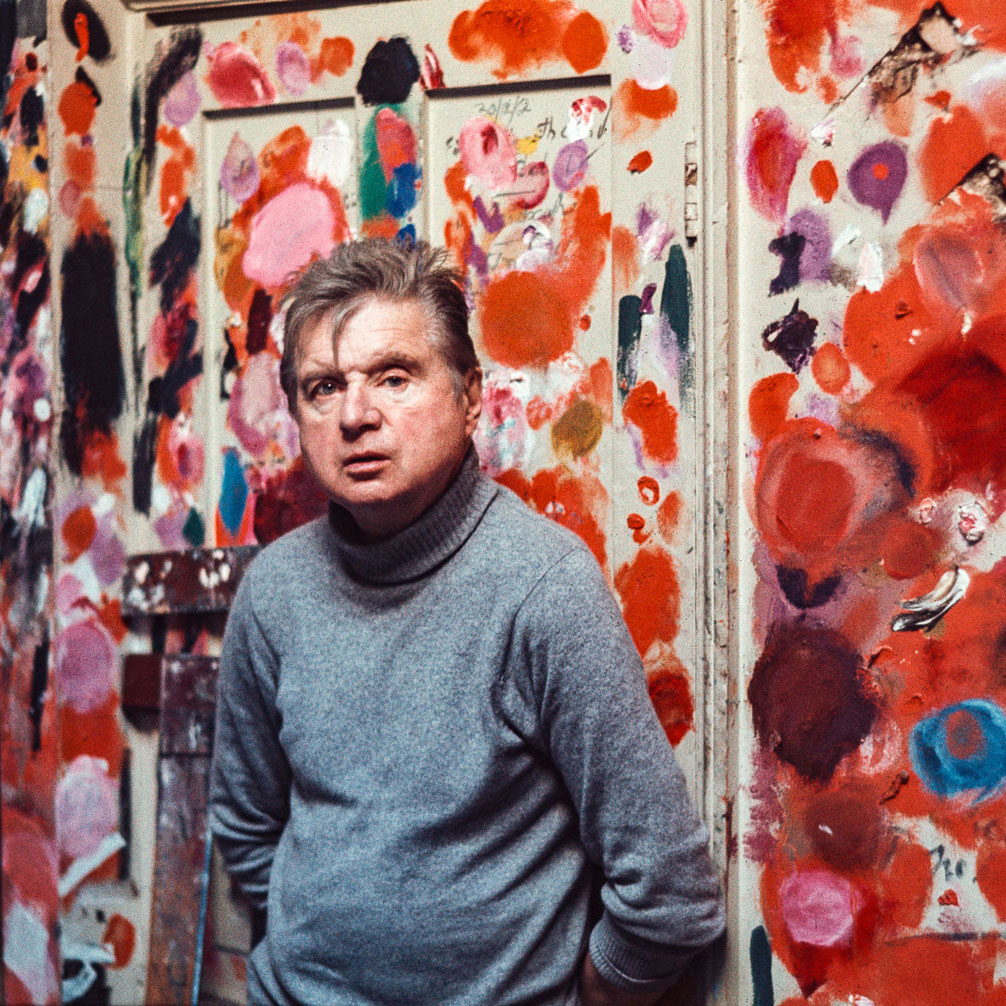
Image: Francis Bacon in his studio.
This is how the art market journal Artforum described Francis Bacon’s London studio as it appeared when he died in 1992. No doubt referring more to the artist’s personal life than his paintings, the magazine declared: “As with so much else in his life, Bacon took tastelessness to an extreme.”
But Bacon’s studios were not always such a mess.
Early in his career, for example, when he was making ends meet by working as a decorator, he resided in a sleek neo-Bauhaus studio. By 1943 he had moved into the grand nineteenth-century studio once occupied by the Victorian portraitist John Everett Millais in Kensington. In 1946, his career taking off with group shows and proceeds earned from the sale of an important early painting, Bacon relocated to Monte Carlo and settled into a large hillside villa. And by 1958, when he signed a 10-year contract with the prestigious Marlborough Gallery that guaranteed him yearly income through advances and sales, Bacon had become a well-heeled bon vivant of the London art scene.
He painted mainly portraits, usually of friends and acquaintances, many of these works dark and haunting. And while he destroyed some of his paintings, his output was prodigious. After Bacon’s death in 1992 at age 82, the value of his paintings started to rise, selling for millions and often setting new records. The highest price for any work by Francis Bacon was achieved in 2013 when Christie’s offered a monumental triptych of 1969 depicting his friend and rival artist Lucian Freud. It made $142.4 million, at the time the most expensive work of art ever sold at auction.
But such otherworldly success in the art market was hardly reflected in Bacon’s lifestyle, which, apart from his well-chronicled gambling, drinking and carousing, was unpretentious.
Which brings us to 7 Reece Mews in South Kensington, Bacon’s residence from 1961 until his death. Originally built as a stable block for the renowned Victorian architect Sir Charles Freake, the house was small and modest, with a bed-sitting room, a combination kitchen and bathroom, and another cramped room in which Bacon painted alone, without studio assistants of the sort artists typically employ today.
Guests were not welcome in the studio, and Bacon’s longtime cleaning lady was forbidden ever to clean it. Over time it began to resemble a hoarder’s paradise.
The studio walls and doors were treated as palettes and smeared with paint. Photographs, paint pots, books and magazines were strewn everywhere, along with upended boxes, empty bottles, drawings and slashed canvases. Dust lay heavily on every surface. “I live in squalor,” Bacon would say proudly of this chaotic, condemned-looking workspace.
After his death his longtime companion John Edwards inherited everything, including 7 Reece Mews and its studio. Even though Bacon had fled his native Ireland at the age of sixteen, Edwards, with a certain poetic irony, arranged for the entire contents of the studio to be donated to the Hugh Lane Gallery in Dublin, thus creating a permanent exhibition and vast archive there of Bacon’s life and work.
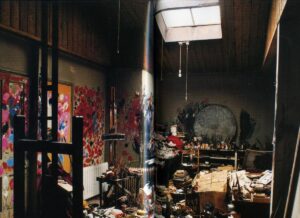
Picture, for a moment, the dizzying prospect of removing this studio and recreating it elsewhere, exactly as it had appeared in London (pictured above).
This task required a large and highly skilled team of archaeologists who made elaborate drawings of the small studio, mapping out the spaces and locations of every single one of its 7000 objects. Conservators then prepared everything for travel, including all the architectural features and fittings, while curators tagged and packed each of the items.
Everything went: the walls, doors, floor and ceiling—even the dust.
As the Hugh Lane Gallery website explains with some understatement, visiting the Bacon studio today is a “visceral” experience:
“Standing in the doorway the visitor can sense the chaos in which Bacon created some of the greatest figurative paintings of the 20th century. The windows to the right reveal a full-length view of the chaotic studio from behind the easel, where empty boxes advertising household goods as well as fine wines and champagne were dumped.”
I have long been in awe of a similar challenge that was faced by the architects Tod Williams and Billie Tsien when they were commissioned to design the new Barnes Museum building in downtown Philadelphia, which opened in May 2012.
Their most daunting task was recreating every room exactly as it had appeared in the original Barnes building in the Philadelphia suburbs, with the same dimensions and detail. The collection involved hundreds of paintings, sculptures, tribal art, murals, diverse decorations, all manner of ephemera, even the quirky metalwork mounted on the walls. The eccentric and imperious Dr. Barnes, one of the greatest art collectors in history, had literally bought Impressionist and Modern masterpieces in bulk on his frequent trips to Paris. Everything then went into a sprawling villa in the Philadelphia suburbs, which was open by appointment only. Nothing could ever be moved, changed or exhibited elsewhere.
It took years of legal challenges in order to free the Barnes collection from its suburban hideaway and move it to a glittering new building, where it could be seen by all. But the placement of everything had to remain precisely the same as Dr. Barnes had originally planned.
Tod Williams and Billie Tsien met that challenge to great acclaim.
Still, I can’t help thinking that the Francis Bacon studio removal tops even that dazzling archaeological achievement.