
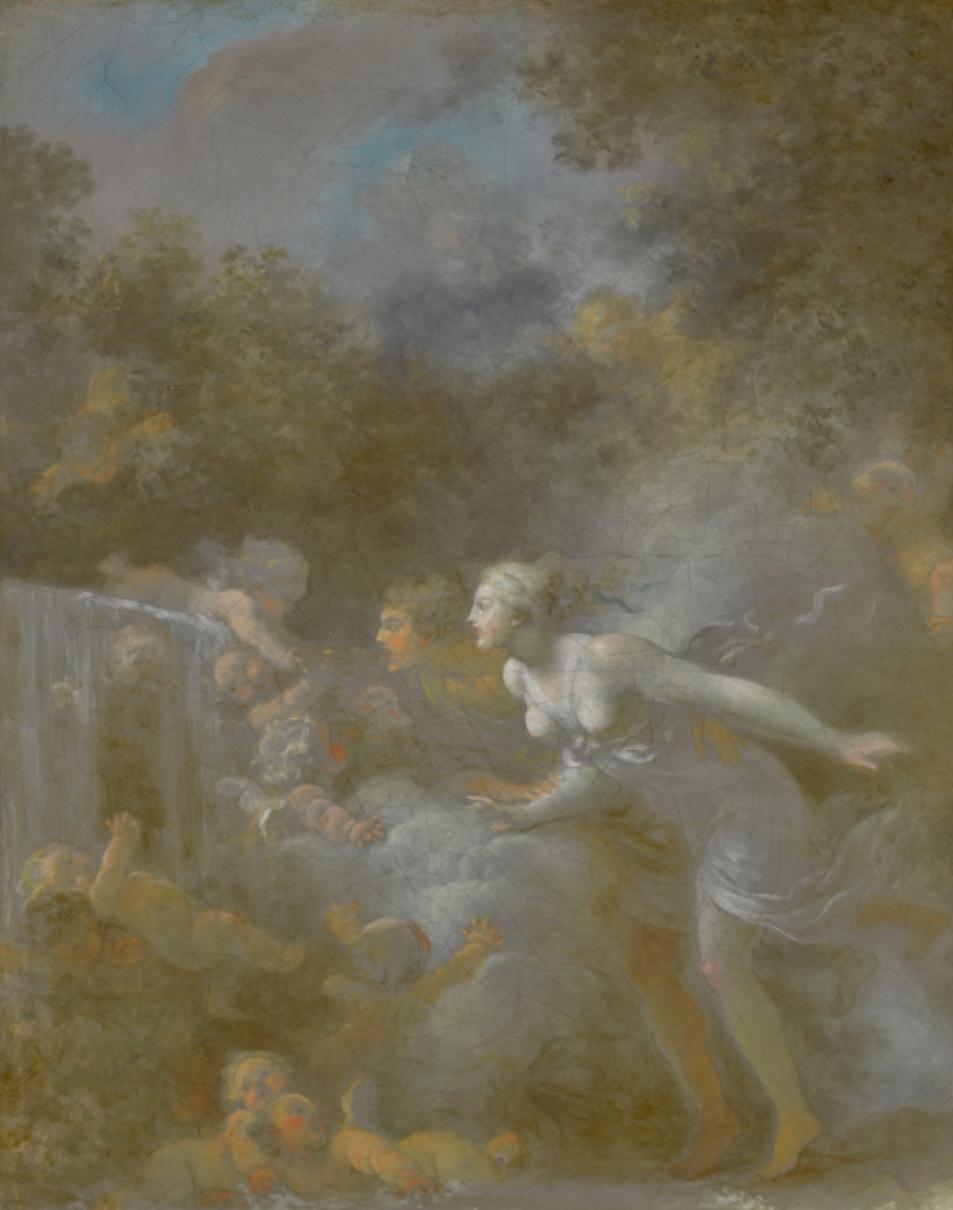
Image: Jean-Honoré Fragonard (1732-1806), The Fountain of Love, oil on canvas
The art market seems increasingly aligned with philanthropy, and one is often startled by the sort of art and collectibles being sold for charitable purposes in the salerooms of Sotheby’s and Christie’s in any given auction season. Diamonds may be sold to benefit animal rights causes or wine to enrich a college’s endowment.
The possibilities are endless.
One such sale particularly caught my eye, as it seemed such an amazing—almost fantastic—crossover of art and philanthropy, for a rare and erotic 18th century French painting was being sold to benefit youth ice hockey in America.
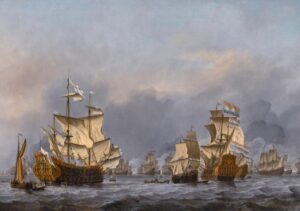
The sale in question took place at Sotheby’s in London in July 2022, a typical Old Masters evening auction featuring an array of Dutch shipping scenes and still lifes, English landscapes and horse portraits, and various paintings of the Virgin and Child. The auctioneer for the sale was the Chairman of Sotheby’s UK, Harry Dalmeny, known more formally as Lord Dalmeny, the 4th Earl of Midlothian and the 8th Earl of Rosebery. His aristocratic presence on the rostrum was perfectly suited to a sale of paintings emblematic of old-world collecting tastes, notably the star lot: a monumental work by William van de Velde the Younger, considered the greatest marine painter of the Dutch Golden Age, entitled The Surrender of the Royal Prince during the Four Days’ Battle, 11-14 June 1666 (pictured above).
The painting had hung in the Rijksmuseum for the past decade, apparently on loan, and it was now being sold with the intriguing designation: “Property of the Stichting Kramer-Lens, sold to benefit the acquisition of the 1718 Stradivarius Violin.” This immediately piqued my interest, and I soon discovered that a stichting is a Dutch legal entity “with limited liability, not aiming to make a profit, with no members or share capital, that exists for a specific purpose that is serving a public, social or idealistic interest.
And clearly the specific purpose being served here was the purchase of an extremely rare violin. However, as fate would have it, the estimate of £4,000,000-6,000,000 for the painting proved too rich for bidders and it failed at £3,200,000.
A happier result ensued shortly thereafter for the sale of a dreamy painting by Jean-Honoré Fragonard entitled The Fountain of Love, which carried an estimate of £200,000-300,000. The painting was a preliminary oil study for one of Fragonard’s most celebrated works of the same title, with one finished version now hanging in the Wallace Collection in London and the other at the Getty Museum in Los Angeles.
I could barely take my eyes off the painting as Lord Dalmeny started fielding bids from the room and over the phones, for it was so ethereal and shimmering, so very different from the battle scenes or religious paintings so common in such sales. A bidding war now commenced that went on for several minutes, ultimately yielding a price for the painting of £718,000.
But what really stood out for me was the designation for the lot: “Sold to benefit the Edward M. Snider Youth Hockey Supporting Organization.” A quick online search told me that Edward M. Snider was the late owner of the Philadelphia Flyers professional hockey team, and that his foundation had been established for the purpose of creating “opportunity for under-resourced youth of the greater Philadelphia Region to prosper in life.”
Here was a vivid example of art in the service of philanthropy, and yet what a stunning contrast it seemed that a serene Old Master painting once gracing the elegant homes of grandees in Paris and New York was now being sold to benefit underprivileged kids. Perhaps this is why bidding on the painting was so robust, both for the work itself and for the cause it was serving.
After watching the sale online, I kept wondering if perhaps that heroic marine scene by William van de Velde the Younger might have found greater saleroom enthusiasm with a more emotionally-stirring beneficiary in mind.
A lower estimate might have helped as well.