
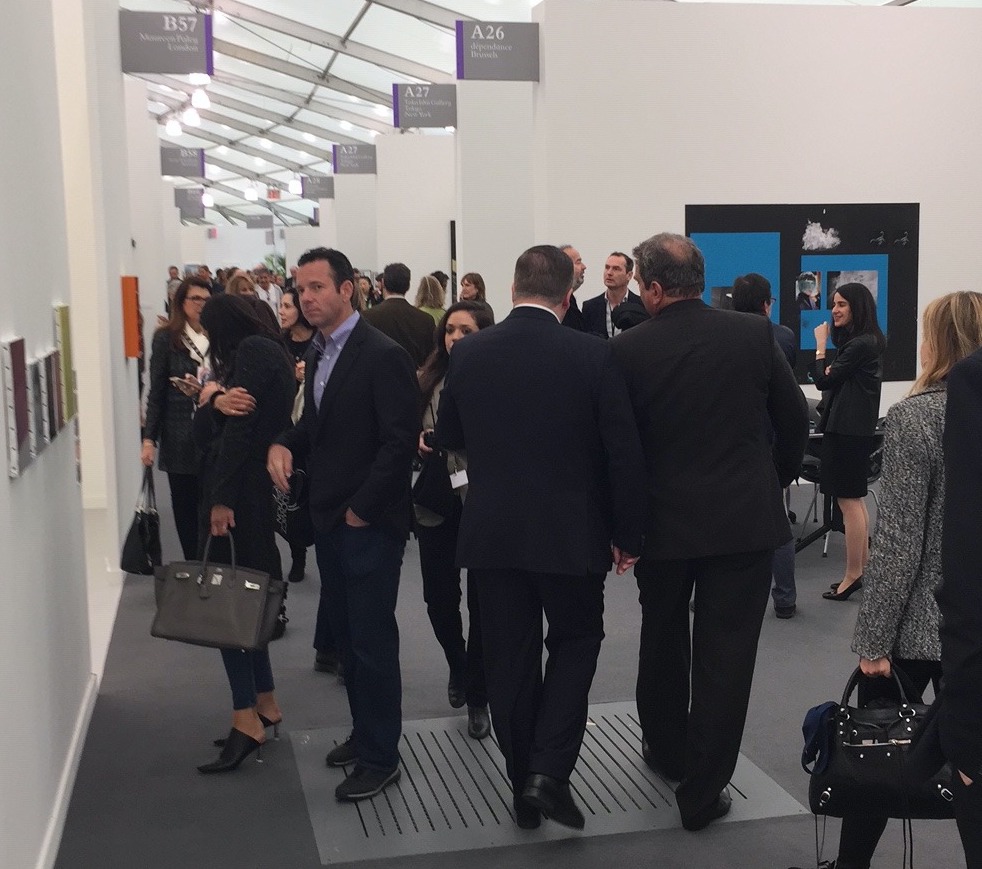
If all had gone according to plan, Frieze New York would have opened this week on Randalls Island. It is a gray parcel of land, home to a Fire Department training academy, a sports stadium, cemeteries and asylums. But once a year it transforms itself into a glittering city of white tents crammed with contemporary art galleries from around the world. The Patrons Night would have launched a week of frenzied and flamboyant art market commerce. But all that was cancelled. Instead there is a “Frieze Viewing Room” of gallery highlights on the fair’s digital platform.
In recent days a flurry of online articles has appeared prophesying bold changes in the art market. Many have been written specifically with art galleries and fairs in mind. One such article, written by a Chelsea gallery owner, angrily began by describing the art market as a “bloated, predatorial, and over-industrialized art complex.” It then predicted the following:
There will be a revolution. Art fairs will be dead for a long, long time, maybe forever. Gallery culture will be redefined. Survival will be based on innovation, adaptation, flexibility…and smallness.
While I don’t foresee a revolution taking place in the art market, it will certainly downsize for a time. Art galleries will change, and survival for many will prove impossible. But I don’t see many participants truly striving to go smaller. For the art market is like the state of Texas. It will always think big.
As for art fairs, while dozens are still on the calendar for the coming months, many may yet be cancelled, with some collectors fearful of large crowds and thus staying away. But the art market has always been an intensely social realm. It attracts crowds, stirring excitement around a shared passion. Art fairs fulfill that social aspect, and brilliantly.
I recall, for example, visiting Frieze New York in 2016 with my daughter. In a heavy rainstorm we took a taxi out to Randalls Island, the roads there a muddy, chaotic mess. But the white tents loomed magically. We ate lunch at the Deutsche Bank VIP lounge and then strolled amidst the crowded, clamoring booths, the fair like a three-ring circus with thrills beckoning in every direction. Whether you liked much of the art on offer was almost beside the point.
So Frieze New York will return. And the art market as we have known it—so proud and full of itself, but also charming and irresistible—will adapt, reinvent itself, and continue growing.