

Image: Exhibition catalogue for Lee Krasner: Recent Paintings, April – May, 1973, Marlborough Gallery, New York.
There is so much pumped-up intrigue and drama in the art market that when something truly startling and newsworthy happens one’s attention is seized.
This was the case recently when the venerable Marlborough Gallery—founded in 1946 and one of the most blue-chip art galleries in the world—announced that it would be closing in June of this year after eighty years in business. As a result, the gallery inventory of many thousands of works will be sold or returned to artists, and all four gallery operations—in London, New York, Barcelona and Madrid—will be “sunset,” as the gallery announced with a sort of poetic euphemism.
The term “family dysfunction” immediately came to mind when I read about the closing.
For family dysfunction is the cause of much misery and mayhem in the art world. One could say it was ultimately the cause of Marlborough’s decline and fall.
In 2020, for example, there was the following lurid headline in ARTNews about Marlborough family affairs:
“As he lay battling for his life, after testing positive for Covid-19, the board used his condition for their own advantage, and voted while he was incapacitated to permanently close the New York gallery.”
By way of backstory, it seems that the two ownership branches of the Marlborough family, the Lloyds and the Levais, had in 2020 drawn swords in a battle over control, with money stirring a dark undercurrent of intrigue and revenge. The London branch of the family seemed to have won the battle over the New York branch in what was described at the time as a “ruthless coup.”
But it was only a Pyrrhic victory. The family dysfunction would continue.
Hearing the news of the gallery’s closing, I wanted to visit their website while still up, for it provides an engaging history told in old photographs, newspaper clippings, exhibition catalogue covers and a stirring, almost heroic year-by-year timeline of triumphs. Marlborough was arguably the greatest contemporary art gallery of its day, blazing a trail for many others that have, in time, surpassed it.
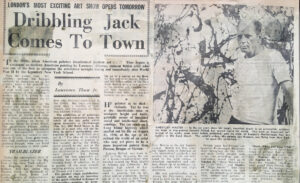
Marlborough certainly played the leading role in developing the Post-War and Contemporary art market as we know it today. And they were ahead of their time in creating publicity around their artists. One faded newspaper clipping of May 1961 (illustrated right) on the Marlborough website, for example, is from a London newspaper and shows Jackson Pollack in his studio, standing in front of one of his drip paintings, wearing a t-shirt and scowling for the camera. The catchy headline reads: “Dribbling Jack Comes to Town.”
Of course, there was scandal as well, notably the unpleasantness that unfolded after the suicide in 1970 of one of Marlborough’s star artists, Mark Rothko. In legal proceedings that lasted years and involved armies of lawyers and much damning testimony, Marlborough was accused of defrauding Rothko and his estate (notably the heirs, his two children) through Byzantine methods of self-dealing involving hundreds of Rothko’s paintings, murky offshore bank transactions, massively unwarranted sale commissions and other forms of greed and deceit that shocked even the judges.
Careers were ruined, including that of Marlborough’s charismatic founder Frank Lloyd.
And so this glamorous and iconic art gallery is closing its doors for good. One will miss its elegant space on West 25th Street in Chelsea, that thriving and overpopulated art district that seems to have vastly more artists and art galleries than the market can possibly absorb. But as it fades into the sunset, Marlborough is doing its part to ensure the future of Chelsea.
As announced, a portion of the proceeds from the sale of its robust inventory “will be donated to nonprofit institutions that support contemporary artists.”