
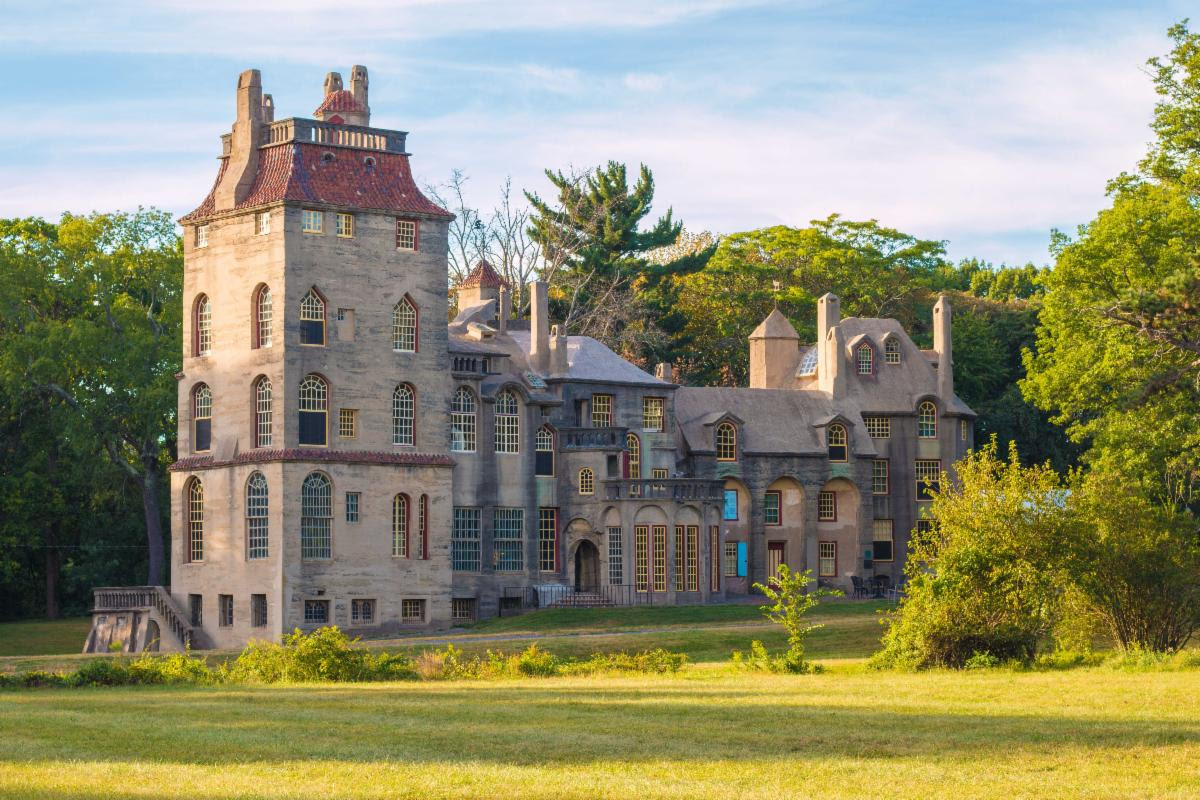
Image: Fonthill Castle, Doylestown, Pennsylvania, built 1908-1912
The history of the art market is perhaps most vividly told in the stories of collectors through the ages, their exploits and adventures, their oddities and eccentricities. Often these collectors are wealthy and charismatic, able to pursue their fantasies unhindered by expense or public opinion.
Such was the case with Henry Chapman Mercer (1856-1930), a Harvard-trained archeologist and amateur architect fascinated with arts and crafts and ancient artifacts. In 1898 he founded the Moravian Pottery and Tile Works, designing and building a small factory made of cement on his estate in Doylestown, Pennsylvania. And as Mercer despised industrialism and mass production, and seemed uncaring of financial gain, his factory was like an atelier devoted to art for art’s sake. Still, as a going concern, it flourished.
Mercer also designed and built another cement structure, a rambling and idiosyncratic forty-room mansion within view of his factory. It became the repository of his personal collection. He named the place Fonthill Castle, perhaps as an homage to the legendary 19th century English collector William Beckford, whose Gothic Revival country house, also made of cement, was named Fonthill Abbey (or more commonly “Beckford’s Folly.”)
Having spent many weekends in Bucks County but rarely venturing into Doylestown, I was intrigued to learn of Mercer and to visit the Moravian Tile Factory and Fonthill Castle, both now maintained by the Bucks County Historical Society. Indeed, the factory still makes decorative tiles from the original molds, and I was delighted to tour the place and buy several works that struck my fancy. And while the place is dark, gritty and scarcely changed from when it was built in 1912, it proudly carries on the arts and crafts traditions that Mercer so revered.
The atmosphere of Fonthill Castle seemed at first cold and sterile. Prints, battered old books, photographs, landscape paintings, broken-down furniture and cardboard file folders stacked high seemed to comprise the “collection,” the lofty rooms reminding me of the Brutalist cement interiors of the old Whitney Museum building.
And yet the true collection was all around you, on the ceilings and walls: Thousands of colorful tiles made by the factory, many of them illustrating fables, homilies and Biblical themes. They were glorious and mesmerizing.
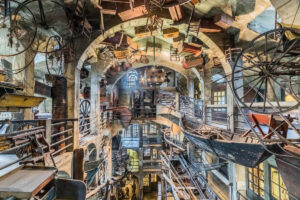
But there was a third Mercer building, a museum, looming like a fortress in the business district of Doylestown (illustrated right). This was the quirkiest place of all, a mammoth cement warehouse of antique carriages and boats, primitive farm tools, old country store and post office interiors —a showcase of life in America before the Industrial Revolution and all artfully curated by Henry Mercer. Over many decades he had scoured the country in search of these old implements and conveyances, hoping to preserve them for posterity.
And here they were, hanging from the rafters and floating in mid-air, a musty indoor theme park of the past. I couldn’t help thinking: What a contrast this all seems to the current art market!
For the art market today continues to blaze across the sky like a meteorite, hurtling ever farther from traditional realms of collecting and toward the flashier field of luxury goods: Hermès handbags, Nike sneakers, celebrity memorabilia, Rolex watches and so on. It seems more and more about status than collecting.
One is thus thankful for the preservation of the past and for old-fashioned collectors and connoisseurs like Henry Chapman Mercer.
Long live his kingdom of cement.